

Underwater treasures
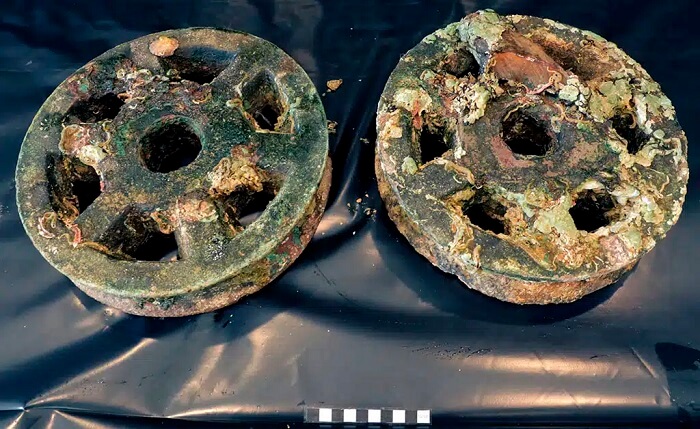
An archaeological campaign carried out in the bay of Lagos between October 9 and 20 uncovered two bronze pulleys that are around 300 years old, with more underwater treasures still waiting to be recovered. After almost five hours at sea, a team of divers from the National Centre for Nautical and Underwater Archaeology (CNANS), together with partners from the Norwegian Maritime Museum, managed to retrieve the two pieces, despite the adverse weather conditions.
The pulleys are believed to have belonged to an 18th-century vessel and were used to carry goods via cables, archaeologist Gonçalo Lopes, who is coordinating the latest sea campaign carried out under the “Water World” project, told Lusa news agency.
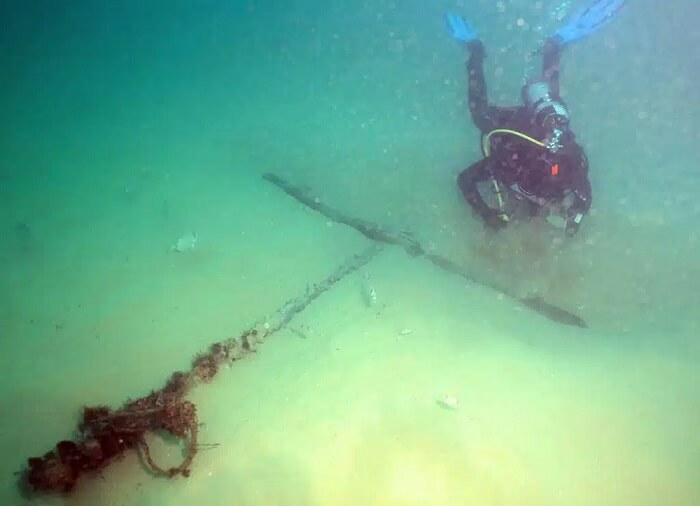
The divers also found a lead stump belonging to a Roman anchor dating from between the 4th century BC and the 2nd century AD, which was not recovered due to the bad weather at the time. According to José António Gonçalves, coordinator of CNANS, these stumps are relatively common in sheltered areas of the Portuguese coast and often belong to anchors that may have been “sacrificed for the sake of manoeuvres or to speed up navigation”.
As the stump is “easy prey” for theft to be sold on the “parallel market” – even more so in this case, considering that the stump is located in a recreational diving area – the aim is to try to recover it as quickly as possible. Three other stumps of different types from the same era have already been recovered in that area, which indicates that it was an anchorage area, says Gonçalo Lopes.
As for the pulleys, they will be treated by the CNANS laboratory and undergo conservation and restoration works so that they can later become part of the Lagos Museum’s exhibition circuit.
Many of these findings were identified by Christiane Kelkel, a German diving instructor who has lived between Germany and Lagos since 1994 and has since made 3,500 dives in these waters. Over the years, the diver has been identifying artefacts on the seabed and reporting their location to the authorities so that they can then be verified, recorded, and, when possible, lifted from the seabed.
During the campaign, which was backed by Lagos Council, areas where shipwrecks had already been inventoried were mapped, this time being scanned by a sonar from the Norwegian Maritime Museum, archaeologist Morten Reitan told Lusa. In fact, one of the shipwrecks had a Norwegian flag and was torpedoed by a German submarine during the First World War, which caused a stir among Norwegian archaeologists.
“It’s fascinating to see how the ship is drawn on the screen as we use (the sonar), knowing that it has more than 100 years of history. It’s one thing to read about it, but seeing the traces gives you goosebumps,” said Reitan. However, the sinking of this ship had a happy ending: “We lost many ships in the First World War, but this was a gentleman’s sinking. It wasn’t brutal, the crew made it to Lagos, and everyone survived,” he said.
The team that took part in the campaign was made up of eight members, including archaeologists and conservator-restorers from CNANS and the Norwegian Maritime Museum, with the participation of the Institute of Archaeology and Palaeosciences of the New University of Lisbon.
The CNANS, which belongs to the Directorate-General for Cultural Heritage, is the entity responsible in Portugal for determining the scientific and heritage value of archaeological assets deposited in aquatic environments.
The archaeological work in the Bay of Lagos is part of the fourth and final campaign under the “Water World” project, which will come to an end in March 2024.